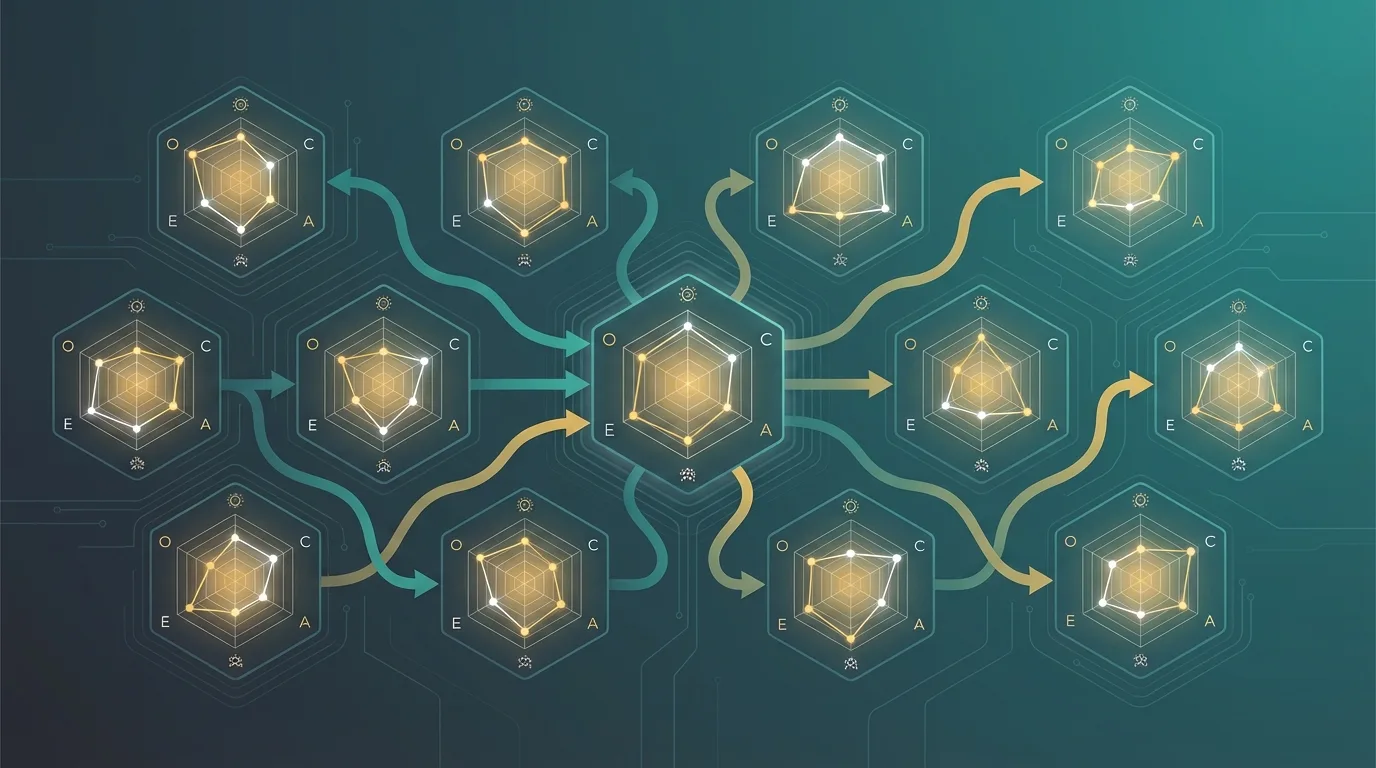
If you’ve ever asked yourself “what personality profile should I look for in this role?”, now you have the answer.
We just launched the Roles & OCEAN+ Profiles Guide: a free tool with 187 personality profiles across 18 industries, now with variants by company size — from tech and product to mining, banking, and agribusiness, adapted to startups, SMBs, enterprises, and global corporations.
What is the Roles Guide?
It’s a library of psychometric profiles based on the OCEAN+ model (the Big Five personality factors plus Structure & Rhythm). For each role you’ll find:
- Ideal ranges across the 6 OCEAN+ dimensions — not a fixed number, but a range that reflects the real variability of the role
- Variants by company size — profiles tuned for Startup, SMB, Enterprise, and Global, because a Product Manager at a startup needs a different profile than one at a corporation
- Behavioral interview questions designed to assess each dimension, contextualized to the segment
- Red flags specific to each company type
- Career path with likely transitions, fit score, and origin roles
- Similar roles to explore nearby profiles
- Talento Index archetype — one of 10 workplace personality archetypes that sums up the profile in a memorable category
New: Profiles by Company Size
A Product Manager at a 10-person startup doesn’t need the same profile as one at a 500-person enterprise. Until now, most personality frameworks ignored this difference. We don’t.
Each role now has up to 4 variants adapted to the organizational context:
| Segment | Headcount | What changes? |
|---|---|---|
| Startup | 1-50 | High tolerance for ambiguity, versatility, fast execution |
| SMB | 51-200 | Balance between structure and flexibility, professionalization in progress |
| Enterprise | 201-1000 | Matrix navigation, cross-functional influence, defined processes |
| Global | 1001+ | Political intelligence, multicultural influence, distributed leadership |
The variants aren’t copies — each one has tuned OCEAN+ ranges, specific strengths, its own red flags, and contextualized interview questions. That’s 182 roles with automatic variants, which brings the guide to 938 pages.
Practical example: A Product Manager at a startup needs Openness 80-95 and Extraversion 65-85 (they have to sell the vision). At an enterprise, Openness drops to 70-85 and Conscientiousness rises to 75-90 (they have to navigate processes and stakeholders). Compare for yourself →
Why ranges and not fixed scores?
Because people aren’t formulas. A Product Manager with 70 in Openness can be just as effective as one with 85 — what matters is being within the healthy range for the role. Ranges capture that reality.
Each profile includes a radar chart that visualizes these ranges at a glance. Here’s what the base Product Manager profile looks like, for example:
Resilience in the face of shifting priorities, feedback, and business pressure
How to read the radar chart:
- Solid line — the ideal maximum of the range for that role
- Dotted line — the ideal minimum of the range
- Band between the two — the “green zone” where the ideal candidate should fall
A score outside the range doesn’t automatically disqualify anyone, but it’s a signal to dig deeper in the interview.
Explore the full profile: Product Manager →
The 6 OCEAN+ dimensions
The OCEAN+ model extends the 5 classic personality factors (Big Five) with a sixth dimension specific to the workplace context:
| Dimension | Code | What it measures |
|---|---|---|
| Openness | O | Curiosity, creativity, openness to new ideas |
| Conscientiousness | C | Organization, discipline, results orientation |
| Extraversion | E | Sociability, energy, communication |
| Agreeableness | A | Cooperation, empathy, teamwork |
| Emotional Stability | EE | Resilience, handling pressure, balance |
| Structure & Rhythm | ER | Preference for defined procedures, steady pace, tolerance for ambiguity |
18 industries, 187 roles, 938 pages
The guide covers roles in:
- Technology — Frontend, Backend, DevOps, ML, QA, SRE, Cloud, and more
- Artificial Intelligence — AI Engineer, Prompt Engineer, ML Ops, LLM Specialist, CAIO
- Product & Design — PM, UX, Growth, Product Owner
- Sales & Commercial — SDR, AE, Sales Manager, Revenue Ops
- Marketing — Growth, SEO, Content, Brand, Performance
- Leadership — CTO, VP, Director, Head of Engineering
- Finance — FP&A, Controller, CFO, Auditor
- Operations — Supply Chain, Facilities, Business Analyst
- BPO & Contact Centers — Agent, Team Lead, QA, WFM
- Banking & Insurance — Risk Analyst, Compliance, Bank Officer
- Mining, Oil & Gas, Construction — Safety, Geology, Projects
- Logistics, Pharma, Agribusiness, Healthcare — and more
Every profile is browsable with filters by industry, level (Entry, Mid, Senior, Director, Executive), and company size.
Connected career paths
One of the most powerful features: each role shows a visual career map with:
- Origin roles: Which positions do people come from to reach this role?
- Next steps: Where can someone grow from here?
- Fit score: How compatible is each transition based on OCEAN+ profiles?
This lets you understand not just what to look for today, but how to think about people’s growth within the organization.
How to use it?
For recruiters and HR managers
- Before posting a job: Check the role’s profile to define which personality traits to prioritize — and pick the variant that matches your company size
- During interviews: Use the behavioral interview questions contextualized to the segment
- When shortlisting: Compare OCEAN+ assessment results against the role’s ideal ranges for your type of organization
For hiring managers
- Define the ideal profile: If you don’t know how to describe what you’re looking for, the profile gives you a concrete starting point — adjusted to whether you’re a startup, SMB, or enterprise
- Assess team fit: Compare the role’s ranges with those of current team members
- Plan succession: Use the career paths to identify internal candidates
For candidates
- Self-awareness: Interested in a role? See if your profile falls within the ideal ranges for the type of company you want to work at
- Explore careers: Browse the career paths to understand which transitions are most likely
- Prepare for interviews: The behavioral questions tell you in advance what they’ll be assessing based on the organizational context
Talento Index Archetypes
Each profile now includes a workplace personality archetype — one of 10 Talento Index archetypes that sums up the role’s dominant work style. This makes communication between HR and hiring managers easier: instead of talking about “Openness 75-90 and Conscientiousness 70-85”, you can say “we’re looking for a Strategic Explorer profile”.
Archetypes are assigned automatically based on the role’s OCEAN+ ranges and its category. Each one has a visual badge that appears on the profile page.
Free access
The Roles & OCEAN+ Profiles Guide is completely free and open. No sign-up required.
Explore by company size: Startup · SMB · Enterprise · Global
And if you also want to assess candidates or teams using automated OCEAN+ assessments, start free with Talen.to.
Missing a role you need? Want to tune the ranges for your company? Write to us — we keep expanding the guide.
Keep exploring

Related OCEAN+ profiles
Discover which personality dimensions to look for in each role.
Related Articles

Exit Interviews: What to Ask and What to Do With the Answers
Three in four companies run exit interviews and almost none change anything based on what they hear. The problem is who asks, when, and what happens afterward.

How to Reduce Time-to-Hire Without Lowering the Bar
The process is not slow because of the interviews. It is slow because of what happens between them. Where the time actually goes and which levers move it.

Individual Development Plan: How to Build One That Sticks
Feedback improves performance on average, and in more than a third of cases it makes it worse. What separates an IDP that works from one filed in January.